The Hidden Cost of Boat Ownership Nobody Talks About
When purchasing a boat, most buyers focus on the sticker price, financing options, and perhaps running costs like fuel and insurance. Yet there is a silent financial factor that can dwarf all of these: the boat depreciation rate. Understanding how boats lose value over time is essential knowledge for anyone considering a purchase or preparing to sell. This guide reveals the secrets of boat value retention, providing both buyers and sellers with the insights needed to make financially sound decisions. Whether you are stepping onto the boat market for the first time or looking to upgrade your current vessel, knowing these depreciation patterns will fundamentally change how you approach the transaction.
In short: Boat depreciation is often overlooked but crucial in financial planning.
📋 Quick Summary
- Understand Boat Depreciation: Key to financial decisions
- Ignore at Own Risk: Largest expense during ownership
- Boat vs Car Depreciation: Different factors & market size
- Knowledge Empowers: Buyers/sellers protect against overpaying/guesswork
✅ TIP: Check boat history reports for accurate pricing and maintenance records.
Why Understanding Boat Depreciation Rate Matters
Ignoring depreciation when buying a boat is akin to ignoring the largest expense you will face during ownership. A buyer who pays full retail for a new vessel without considering future resale value may find themselves underwater financially within just a few years. The depreciation hit can easily exceed the combined cost of fuel, maintenance, and storage over the same period.
Boat depreciation differs significantly from car depreciation in several important ways. While cars follow relatively predictable depreciation curves based on mileage and age, boats introduce additional variables such as engine hours, saltwater versus freshwater use, storage conditions, and seasonal demand fluctuations. Furthermore, the boating market is considerably smaller and more specialised than the automotive market, meaning that resale can take longer and pricing is less standardised.
For buyers, understanding depreciation provides powerful protection against overpaying. Armed with knowledge of typical value retention patterns, you can evaluate whether a seller’s asking price reflects fair market value or includes an unrealistic premium. This knowledge shifts negotiating power in your favour and helps identify genuinely good deals versus overpriced listings.
Sellers benefit equally from depreciation awareness. Pricing a boat correctly from the outset attracts serious buyers and reduces time on market. Overpriced boats languish unsold while depreciation continues to erode their value. By understanding what buyers expect to pay based on age, condition, and brand reputation, sellers can set competitive prices that reflect genuine market conditions. This knowledge transforms what might feel like guesswork into an informed pricing strategy.
Bottom line: Understanding boat depreciation is crucial to avoid financial loss due to rapid resale value decline.
✅ TIP: Inspect engine hours, not just age, to gauge depreciation.
How Boats Depreciate: Year-by-Year Breakdown
The pattern of boat depreciation follows a fairly consistent curve, though individual circumstances can cause significant variation. The steepest decline occurs immediately after purchase. During the first year of ownership, boats typically lose around 12.5% of their original value. This initial drop reflects the transition from new to used status, regardless of how little the boat has actually been used.

After the first year, depreciation settles into a more gradual pattern. Expect annual depreciation of approximately 7.5% per year in the subsequent years. This rate continues relatively consistently through what industry observers consider the peak depreciation period, which spans the first 5 years of a boat’s life. During this window, boats shed value most rapidly, making new boat purchases the most expensive in terms of depreciation cost.
The mathematics of this depreciation pattern explain why many experienced boaters avoid buying new. A boat purchased new and sold after five years will have lost a substantial portion of its value to depreciation alone, on top of all operational costs. This reality does not make new boats a poor choice for everyone, but it does mean buyers should enter such purchases with clear expectations about financial outcomes.
Brand reputation plays a crucial role in how boats retain value over time. Premium brands such as Boston Whaler and Grady-White demonstrate remarkably strong value retention compared to average vessels. After 10 years, these premium brands typically retain around 65% of their original value, compared to just 45% for average boats. This 20 percentage point difference represents substantial real money, particularly on higher-value vessels.
Several key factors determine where a specific boat falls on the depreciation spectrum. Brand reputation, as mentioned, establishes a baseline expectation. However, condition and maintenance records can move a boat significantly above or below that baseline. A well-documented service history reassures buyers that the vessel has been properly cared for, justifying higher prices and faster sales. Conversely, boats with gaps in their maintenance records or visible signs of neglect depreciate faster than average.
Engine hours function as a critical depreciation factor, somewhat analogous to mileage on cars but with important differences. High engine hours signal significant use and suggest that major components may be approaching the end of their service life. Buyers factor in potential engine rebuilds or replacements when evaluating high-hour boats, driving prices down accordingly. Boats with lower engine hours for their age command premium prices, as they suggest lighter use and more remaining service life.
The type of use also influences depreciation. Boats used exclusively in freshwater typically fare better than those exposed to saltwater environments, as salt accelerates corrosion and wear on virtually all components. Similarly, boats stored under cover or in climate-controlled facilities show less weathering than those left exposed to the elements year-round.
Market demand fluctuates seasonally and regionally, affecting how quickly boats sell and at what prices. Spring typically sees peak demand as buyers prepare for the boating season, while autumn and winter represent slower periods in most markets. Regional preferences also matter: certain boat types command premiums in specific areas based on local boating conditions and traditions.
Understanding these patterns helps both buyers and sellers make informed decisions. When comparing boat values across different listings, platforms like Aiboatbuddy allow you to evaluate multiple vessels side by side, making it easier to spot fair prices and identify boats that represent genuine value in the current market.
Remember: Boats lose 12.5% in Year 1, then gradually depreciate.
✅ TIP: Sell during peak boating season for higher resale price.
Boat Depreciation Rate: The Numbers You Need to Know
Concrete data helps transform abstract depreciation concepts into actionable knowledge. The following figures represent typical depreciation patterns across the broader boat market and provide benchmarks for evaluating specific vessels.
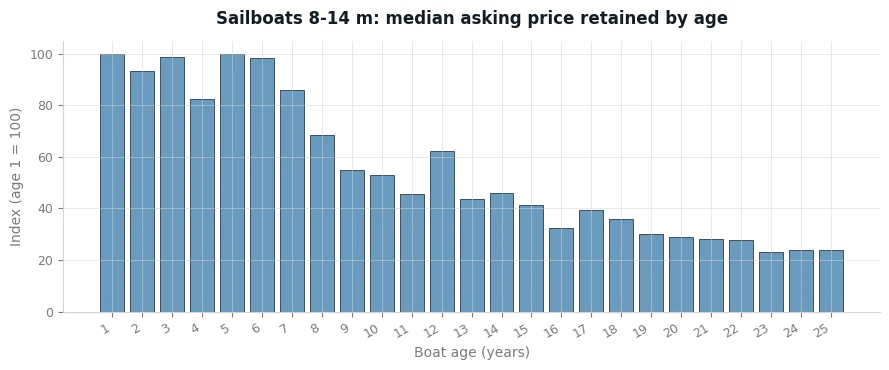
First year depreciation averages 12.5%, making the initial year of ownership the most expensive in terms of value loss. This steep drop occurs regardless of actual usage, reflecting the market’s distinction between new and used vessels.
Annual depreciation after year one settles to approximately 7.5% per year. This rate continues through the peak depreciation period of the first 5 years, during which boats lose the majority of their total depreciation.
After 10 years, the average boat retains approximately 45% of its original purchase price. However, premium brands like Boston Whaler and Grady-White buck this trend significantly, retaining around 65% of their original value at the decade mark. This substantial difference underscores the long-term financial benefits of choosing brands with strong reputations for quality and durability.
The comparison between average and premium retention rates reveals an important insight: paying more upfront for a premium brand may actually cost less in total depreciation over the ownership period. A premium boat that retains 65% of its value after 10 years has lost only 35% to depreciation, while an average boat losing 55% of its value has depreciated considerably more.
The best value buying window falls between 5 and 10 years of age. Boats in this range have already absorbed the steepest depreciation but typically retain plenty of useful service life. Buyers entering this window benefit from someone else absorbing the new-boat premium while still acquiring a vessel with modern features and reasonable remaining longevity. This sweet spot represents the optimal intersection of price and value for budget-conscious buyers.
Key takeaway: Boats typically depreciate 12.5% in their first year.
5 Strategies to Minimise Boat Depreciation
While depreciation cannot be eliminated entirely, smart owners can take concrete steps to minimise its impact on their boating investment.
Target the Sweet Spot: Buy Used Boats Between 5 and 10 Years Old
The most effective depreciation strategy is buying boats that have already passed through their peak depreciation period. Vessels between 5 and 10 years old have absorbed the steepest losses while typically offering many years of reliable service ahead. This approach lets someone else pay the new-boat premium while you enjoy the benefits of modern design and equipment at significantly reduced cost.
Choose Brands with Proven Value Retention
Brand selection has lasting financial consequences. Manufacturers with strong reputations for quality, like Boston Whaler and Grady-White, consistently outperform market averages in value retention. Researching brand-specific depreciation patterns before purchasing allows buyers to factor long-term value into their decision, potentially justifying higher upfront costs that translate into smaller losses over time.
Maintain Detailed Service Records
Comprehensive maintenance documentation provides tangible proof of proper care and significantly enhances resale value. Keep records of all service performed, including routine maintenance like oil changes and winterisation as well as major repairs or upgrades. Organised records demonstrate to future buyers that the vessel has been conscientiously maintained, justifying higher asking prices and faster sales.
Keep Engine Hours Reasonable
Engine hours directly influence buyer perception and resale value. While boats should be used and enjoyed, awareness of accumulating hours helps owners balance enjoyment against future resale considerations. Boats with lower-than-average hours for their age attract more buyer interest and command premium prices. This does not mean avoiding use altogether, but rather being mindful of how usage patterns affect long-term value.
Store and Maintain Properly
How a boat is stored and maintained between uses dramatically affects its condition and consequently its depreciation rate. Covered storage protects against UV damage and weathering. Regular cleaning prevents build-up of contaminants that can cause long-term damage. Proper winterisation in cold climates prevents freeze damage. Fresh water rinses after saltwater use reduce corrosion. These ongoing care practices preserve both appearance and mechanical condition, slowing depreciation and maintaining buyer appeal.
In short: Buy used boats aged 5-10 for minimal depreciation.
⚠️ WARNING: Never Overlook Boat Depreciation
Make Smarter Boat Buying Decisions Today
Understanding boat depreciation rate transforms how you approach buying and selling vessels. The key insights are clear: boats depreciate most steeply in their first year with 12.5% loss, then continue declining at roughly 7.5% annually through the peak depreciation period. After 10 years, average boats retain only 45% of their original value, while premium brands like Boston Whaler and Grady-White hold onto approximately 65%. The optimal buying window falls between 5 and 10 years, where initial depreciation has passed but substantial useful life remains.
Armed with this knowledge, you can negotiate from a position of strength, recognise fair pricing, and make decisions that align with your financial goals. Whether buying your first boat or selling your current one, depreciation awareness protects your investment and helps you extract maximum value from your boating experience.
Ready to apply these insights? Browse boat listings on Aiboatbuddy to compare vessels across different ages, brands, and price points. Finding the right boat at the right price starts with informed comparison, and understanding depreciation ensures you recognise genuine value when you see it.
Bottom line: Optimal boat-buying age is 5 to 10 years old.