
Defensible boat valuations, in seconds
When a seller pushes back on your price, you need more than experience — you need comparables. We aggregate more than 300,000 active listings from across the European used-boat market and return median, p25–p75 and the number of comps behind every figure.
Free, and no account. The documents you hand your clients are €49 a month.

The discount gets taken anyway. It just gets taken later.
The disagreement on listing day is rarely about the whole price. It is about the last few thousand euros: the seller wants them, you don’t think the market will pay them, and you take the listing anyway.
We record what happens next. Across 7,881 price reductions on 7,152 listings asking between €100,000 and €500,000 immediately before the cut, the median reduction was €20,000 — 9.5 % off the asking price. A quarter of them were €34,000 or more, and 312 of those listings cut twice or more.
In the last thirty days we recorded 12,932 reductions of 5 % or more against 1,441 increases. Prices in this market move down far more often than they move up, and they move down in five-figure steps.
You can put the p25–p75 band for that model and year in front of the seller before the listing goes live, or you can put the reduction in front of them months later. It is the same money either way. One is your argument. The other is a phone call you have to make.
Measured 9 August 2026 on recorded price changes of 5 % or more, aggregated across the European used-boat market. Changes smaller than 5 % are excluded: most of them are exchange-rate drift on listings shown in a converted currency, not decisions. Asking prices, not sale prices.
What it changes on a Tuesday morning
- Price it right the first time. The figures above are what a correction costs once the first number is already public. One number, checked against the market before the listing goes live, is cheaper than the conversation that follows a wrong one.
- Answer “why that price?” with the comparables attached. Your experience is still the judgement. The comps are what the seller can see for themselves.
- Minutes instead of an afternoon. Doing it by hand means four portals, a spreadsheet and a lot of tab-switching. This is one form.
- Walk in with something to leave behind. A client-ready PDF per valuation, with the comps shown — instead of “let me put something together and send it over”.
What you get
- Valuation API — brand, model and year in; median, p25–p75, comparable count and confidence out. One call, JSON.
- Broker workspace — run valuations without writing code, save them under client names, and track the brand/model segments you specialise in.
- Client-ready PDF — one click per saved valuation, with the comps shown.
Where the numbers come from
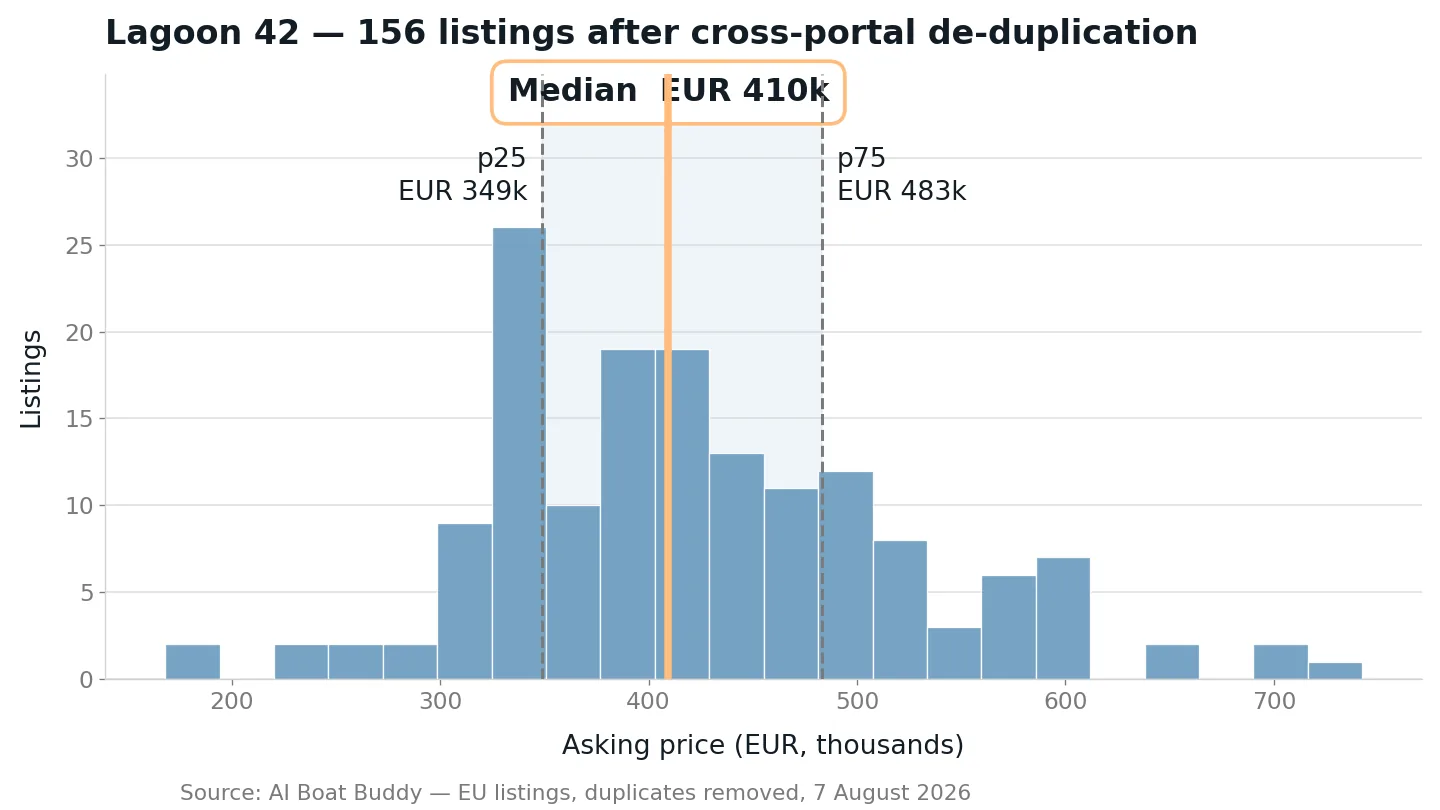
That is one model. Run the same measurement across 2,700 groups of listings that share a brand, a model and a build year — 51,000 boats, at least ten in every group — and the upper quartile of the median group sits €9,800 above that group’s own median. The middle half of a group spans just under 14 % of its median price, and 9 % of listings ask more than 20 % above the median for their own model and year.
Some of that gap is real: engine hours, equipment, VAT status, where the boat lies. Some of it is a seller who wanted a number. Nothing in the data tells you which, and that is the point — your judgement decides where in the band a boat belongs, and the band decides what you are arguing inside of.
More than 300,000 active listings — more than 250,000 with an asking price, and more than 100,000 with a confirmed European location. Aggregated across the European used-boat market, not taken from one portal.
A market, not an archive — more than 100,000 listings re-checked in the last seven days, and more than 17,000 listings we had not seen before in the same period. You price against this week’s market, not last quarter’s.
Over 10 million filled data fields across listings, engines and parts.
Brand names normalised to a canonical form, so “Bénéteau” and “Beneteau” count as the same boat. 1,594 brands carry ten listings or more; 807 carry twenty-five or more.
Median, not average — one distressed listing should not move your number.
Every figure carries its comp count, so you can see when the sample is thin and say so to your client.
There is no single “right” asking price to look up. In our August 2026 checks, the median asking price for the same model and year window came out more than 40 % apart in different corners of the European market. Anyone pricing from one corner of it is pricing from a sample. We put the whole spread in front of you as one median, one band and one comp count.
We check ourselves against the live market. In August 2026 we ran a spot check against 109 live listings we had no hand in choosing: 103 of them — 94 % — were already in our database.
What we don’t know
We measure asking prices, not sale prices. We see what a boat is advertised at, and what it is advertised at next. We do not have access to what European boats actually change hands for. Anyone who claims that number for this market should be asked where it came from.
Comparables are matched on brand, model and a year window. The default is ±3 years. If that window holds fewer than three listings we widen it, and the answer tells you which window it actually used, how many listings stood behind it, and how confident it is. A thin sample is reported as a thin sample rather than filled in.
We measure market value, not condition. A marine surveyor’s report tells you the state of the vessel; a market range tells you what the market is asking for vessels like it. They answer different questions, and the second does not replace the first.
We cannot tell you how long a boat has been on the market. Our timestamps record when we first saw a listing, not when it was first offered for sale — and we are not going to dress our own timestamps up as time-on-market data.
The same boat can be advertised in more than one place. We collapse those duplicates for a chart like the one above. A live valuation call does not do it yet, so on a popular model the comparable count it returns is higher than the number of distinct boats behind it.
Every figure on this page was measured against the live database on 14 August 2026, except where an earlier date is stated beside the figure.
Pricing
The lookup is free. Client documents are €49 a month. Up to 30 a month, which is a ceiling rather than a target — and there is no notice period. Six months is €269 and a year is €490, two months free: same product, same ceiling, you pay less for committing longer. The PDF carries your client’s name on the front page, and comes with a link you can send them and the covering email already written.
If we cannot find at least three distinct comparable listings for that boat, we do not make the document. You keep the free lookup and we tell you why.
What is free, what costs €49, and what our numbers are not →
Larger operations
Yacht-net groups, insurers and lenders with their own integration needs: write to info@aiboatbuddy.com and tell us what you need.